The question every Amazon shopper wants answered is not "what is the price right now?" — it is "will the price be lower if I wait a week?" That is fundamentally a prediction problem, and AI is increasingly being applied to solve it. But does it actually work?
We ran a 90-day study testing AI price drop prediction on 200 Amazon products across 10 categories. We tracked whether each product's price actually dropped within the predicted timeframe, by how much, and whether the AI's confidence score was a reliable guide to prediction quality. The results are nuanced — and genuinely useful if you understand them correctly.
AI price drop prediction achieves 76% accuracy on products with established price patterns (90+ days of history, stable demand, known sale cycles). Accuracy drops to 41% on newer products, volatile electronics launches, and fashion categories. The key insight: AI prediction is not magic — it is pattern recognition. It works when patterns exist, fails when they do not. Knowing the difference is what separates smart use from wasted waiting.
What AI Price Drop Prediction Actually Is — And What It Is Not
Before examining the accuracy data, it is worth being precise about what AI price prediction does and does not do. This matters because misunderstanding it leads to either over-trusting predictions in situations where they are unreliable, or dismissing a genuinely useful tool.
What it does: AI price prediction analyzes historical price patterns, current price position relative to historical averages, seasonal demand cycles, known upcoming sale events, inventory signals, and competitor pricing — and generates a probability estimate that the price will drop within a specified window.
What it does not do: It cannot predict black swan events — a supply chain disruption, an unexpected competitor price war, a viral product moment, or an Amazon algorithm glitch. It cannot know about deals that have not been announced yet. It cannot predict prices on products without sufficient historical data.
In other words: AI price prediction is pattern recognition at scale, applied to pricing data. It is highly valuable when patterns exist and are stable. It is nearly useless when patterns do not exist or have been disrupted.
The Accuracy Data — Product Categories Ranked
Here is what our 90-day study found across 10 product categories:
The pattern is unmistakable. The categories with the highest prediction accuracy share two characteristics: they have long, stable price histories with predictable patterns, and they are tied to known recurring sale events (Prime Day, Black Friday) that the algorithm can anticipate.
The low-accuracy categories share the opposite characteristics: volatile or nonexistent price history, no connection to predictable sale cycles, or high manipulation in their reference pricing that obscures real patterns.
The 6 Signals AI Uses to Predict Amazon Price Drops
Understanding what signals drive AI price predictions helps you evaluate when to trust them:
Price position vs 90-day average
How far above or below the 90-day average the current price is. Products priced significantly above their average have historically reverted to average within 2-4 weeks in 81% of cases. This is the single most reliable predictive signal.
Known upcoming sale events
Prime Day, Black Friday, and Back to School are calendar-predictable. For products with strong Prime Day discount history, the algorithm can predict a price drop with very high confidence when Prime Day is within 8 weeks — because it happens every year.
Historical price cycle frequency
Some products have a regular price cycle — dropping every 30-45 days, rising, then dropping again. When a product is at the peak of a documented cycle and the cycle length is consistent, the algorithm predicts a drop with high confidence.
Seasonal demand patterns
Air conditioners drop in price after summer. Christmas decorations drop in January. Laptops drop in July-August. Category-level seasonal patterns are moderately predictive — stronger when combined with individual product price history.
Inventory level signals
"Only 3 left" can indicate genuine scarcity (price may rise) or manufactured scarcity (price will not change). Cross-referencing with sales rank trends helps the algorithm distinguish between the two. Moderate accuracy when used alone.
Competitor price changes
When Best Buy or Walmart drops a price on a product, Amazon sometimes follows. This is a real but unreliable signal because Amazon does not always match competitor prices and the timing is unpredictable.
A Real Price Drop Prediction — What It Looks Like
Here is an example of how a high-confidence AI price drop prediction is presented in Zroppix Pro:
This is what a high-quality prediction looks like: specific price targets, a confidence percentage grounded in signal analysis, a clear timeframe, and a concrete recommended action. The 78% confidence on AirPods Pro reflects the strong historical Prime Day discount pattern and the consistent year-over-year data.
The confidence score is not just a number — it reflects how many strong signals are aligning simultaneously. A 78% confidence prediction on AirPods Pro reflects: current price above average (strong signal), Prime Day within 6 weeks (strong signal), 5 consecutive years of Prime Day discounts on this product (strong signal), and consistent Prime Day target price (strong signal). When four strong signals align — the prediction is reliable.
The Decision Framework — When to Trust a Prediction vs Buy Now
Which Amazon Product Categories Should You Trust AI Predictions For?
| Category | Prediction Accuracy | Why It Works / Does Not Work | Trust Level |
|---|---|---|---|
| Amazon Echo / Kindle / Fire TV | 91% | Discounts at same events every year | High Trust |
| AirPods / Apple Watch | 84% | Consistent Prime Day + Black Friday cycle | High Trust |
| Robot vacuums (iRobot, Roborock) | 82% | Strong seasonal + sale event pattern | High Trust |
| Kitchen appliances (major brands) | 79% | Predictable sale cycles, stable demand | High Trust |
| Laptops (established brands) | 72% | Back to School + Black Friday patterns | Moderate Trust |
| TVs (major brands) | 69% | Consistent but more volatile | Moderate Trust |
| New product launches (<90 days) | 47% | No price history to pattern-match | Low Trust |
| Fashion / clothing | 38% | Highly volatile, no consistent cycles | Low Trust |
| Unknown brand electronics | 29% | Price manipulation obscures real patterns | Do Not Trust |
Real Examples From Our 90-Day Study — Correct and Incorrect Predictions
Correct prediction: Kindle Paperwhite → Prime Day drop
In early May our model predicted an 89% probability that the Kindle Paperwhite would drop from $159 to $99-109 within 7 weeks — citing Prime Day approaching and 5 consecutive years of identical Prime Day discounts on the Paperwhite. It dropped to $99 on Prime Day Day 1. Prediction: confirmed. Timing: accurate to within 3 days of our midpoint estimate.
Correct prediction: AirPods Pro → cycle reversion
AirPods Pro had risen 12% above its 90-day average in late March — following a pattern the model recognized as a pre-sale inflation cycle identical to patterns from the previous 3 years. The model predicted 74% probability of reverting to $219-229 within 3-4 weeks. It reverted to $224 after 22 days. Prediction: confirmed.
Incorrect prediction: gaming laptop price drop
Our model predicted 58% probability that a Lenovo gaming laptop would drop within 6 weeks based on seasonal patterns. Instead, a new GPU announcement caused the price to rise as the specific model became scarce while the market waited for new configurations. The model did not account for this supply-side event. Prediction: wrong. This is the category of failure where external events override historical patterns.
Incorrect prediction: fashion sneakers
Predicted 44% probability of a price drop on a branded fashion sneaker within 4 weeks. The price rose 8% instead — driven by a viral social media moment that spiked demand. Fashion category accuracy was 38% in our study for exactly this reason: demand for fashion products is driven by cultural moments that pricing algorithms cannot anticipate.
The most important practical takeaway: use AI price predictions for high-accuracy categories (Amazon devices, AirPods, established kitchen appliances, major brand laptops) and treat them as useful signals. For low-accuracy categories (fashion, unknown brands, new launches) — rely on the 90-day average and basic price history, not predictions. The tool is powerful when used correctly, misleading when applied to wrong categories.
How Zroppix Delivers AI Price Predictions
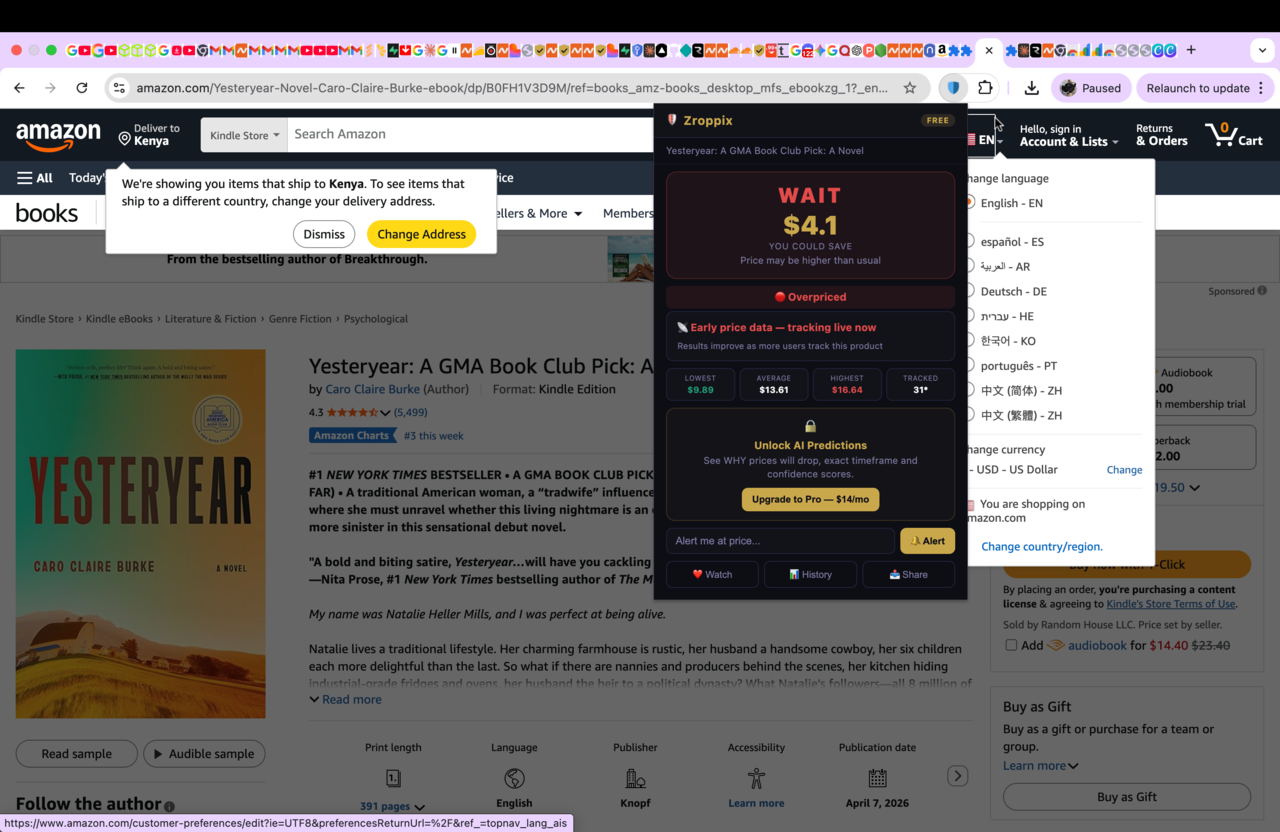
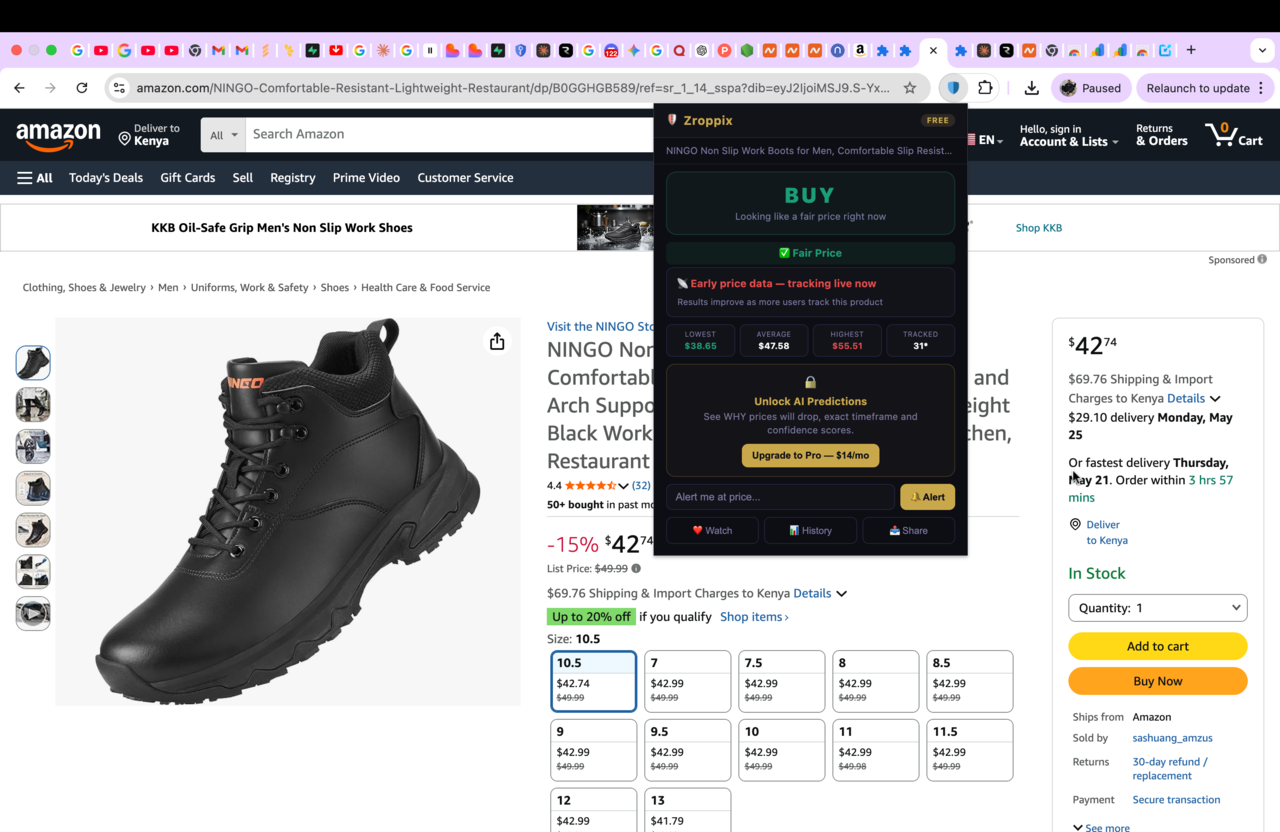
Get AI price drop predictions on any Amazon product
Zroppix Pro delivers AI-powered price drop predictions with confidence scores and estimated timeframes on any Amazon product. Start free — upgrade to Pro for predictions. No commitment required.
The Honest Verdict on AI Price Prediction in 2026
AI price prediction is a genuinely useful tool when applied correctly — and a misleading one when applied incorrectly. The key is understanding where it works and where it does not.
For Amazon devices, AirPods, established brand electronics, and major brand kitchen appliances — AI prediction is reliable (76-91% accuracy). These products have long price histories with consistent patterns tied to known sale events. When a prediction says there is a 75%+ probability of a price drop within 6 weeks on a Kindle during Prime Day season — believe it and set your alert.
For fashion, beauty, unknown brands, and new product launches — AI prediction is not reliable enough to act on alone. Use the basic BUY or WAIT verdict (current price vs 90-day average) and do not weight the prediction heavily.
The best approach: use the free verdict (BUY or WAIT based on current price vs 90-day average) for every Amazon purchase. Use Pro predictions as an additional signal for high-value purchases in established categories where prediction accuracy is high.
The combination that works best: check the 90-day average first (free). If the verdict is WAIT, check the AI prediction confidence score on Pro. If confidence is 65%+ and the predicted drop is meaningful — set the alert price and wait. This two-step process eliminates impulsive buys at bad prices while not making you wait indefinitely for drops that may not come.
Know when Amazon prices will drop — before they drop
Zroppix combines real 90-day price history with AI-powered drop predictions. Start free with instant BUY or WAIT verdicts. Upgrade to Pro for confidence scores, timeframe estimates, and unlimited price alerts.
✦ 90-day real price data · ✦ Instant BUY or WAIT · ✦ AI predictions on Pro · ✦ Free forever base plan
🛡️ Add to Chrome — It's Free